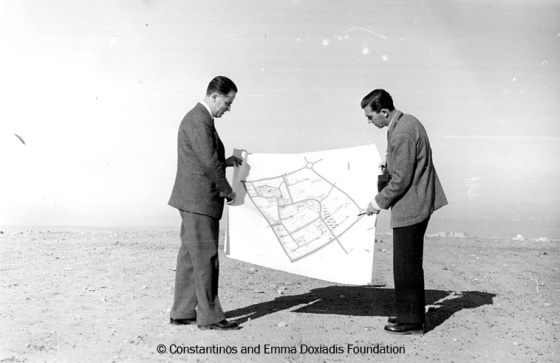
For the past decades Detroit has been synonymous for urban decay, while today its apocalyptic landscape poses a challenge for professionals and investors claiming to provide a vision for its future. This study aims to understand the complex dynamics that led to the abandonment of the city and invalidated the attempts to reverse the decline started in the sixties. Among them, “Doxiadis Plan” stands out for having presented a long-term vision based on a set of integrated programs and following “scientific” guidelines. The study carries out a comprehensive analysis of Detroit’s structural problems highlighting their interactions that formed a downward spiral leading the city to decline. Moreover, It examines the “Doxiadis Plan” in its historical context and draws parallels with contemporary initiatives, in order to explain its failure while reviewing its optimistic vision towards the new promises. Envisioning Detroit’s post-industrial future one should integrate its past.
Rethink Athens is a European Architectural Competition organized and funded by the Onassis Foundation promoting the revitalization of the Athenian center. Undoubtedly, this is the most ambitious effort, among a series of architectural competitions on public spaces or buildings, to shape downtown Athens and stimulate growth towards resiliency – to use the socially friendly mirror term of sustainable development.
The competition was set against the background of a crisis that during the past years has magnified urban and social ills – not to mention nationalist spirit, and this is probably the reason that the results have generated an unprecedented political paraphernalia on the Athenian urbanism.
While waiting the much promised debate on the objectives and development of the project, worths considering other proposals that have contributed in their way, yet barely discussed.
The second prize was awarded to a group of young architects (Kiki Ilousi, Oihana Iturritxa Kerexeta, Dimitris Gourdoukis, Theodora Christoforidou, Katerina Tryfonidou, Fotis Vasilakis) whose proposal, much alike the winning one, figured a network of open and green spaces around the central intervention axis, integrated in the Athenian ecosystem.
The utopian proposal award went to Kostas Tsiambaos and Myrto Kiourti who suggested a different land ownership structure stating that “the catalyst towards a new city center will be its active and responsible citizens and not its superficially redesigned image”.
The winning proposal “One Step Beyond” was submitted by OKRA, in collaboration with Mixst urbanism and Wageningen University. In the forthcoming months, OKRA will develop a plan scheduled for implementation in 2015, under the auspices of the Onassis Foundation and via European Funding. Provided that such an option is still on the table…
Welcome to DHA City Karachi (DCK) # The first planned sustainable & green city of Pakistan
Situated on the Karachi-Hyderabad Superhighway, 56 kilometers from the center of Karachi (the financial centre of Pakistan and a global city with an estimated population of 21 million people), DHA City is conceived as an urban model for the 21st century. DHA city comprises 50,000 residential and commercial plots, specialized healthcare and higher education institutes, a convention centre, and a high-rise CBD called DCK downtown. According to the project, the aforementioned facilities introduce new standards of planning adapted to the local conditions, while the planning approach draws on sustainable design principles. As such, the downtown district will be defined by a car free pedestrian spine with tree-lined pathways, garden courtyards, water features and piazza’s.
Still, DHA City comprises Golf Club resorts, theme parks, Lakeview parks, Mall Zones and similar facilities that promise a most “exciting and thrilling entertainment experience.”
Still, the promotional video features a different lifestyle in the DHA City: security towers, checkpoint, central entrance gate, electronic surveillance system, and milestone ceremonies with military officers.
The master plan of DHA City is a joint collaboration of Doxiadis Associates, RMJM (Robert Matthew Johnson Marshall), Osmani & Company (Pvt) Ltd, Karachi, Pakistan, and Professor Spiro Pollalis from the GSD Harvard University as chief planner. Construction on the new city is expected to start in early 2012, with full completion expected by 2030.
Still D: DHA’s Past
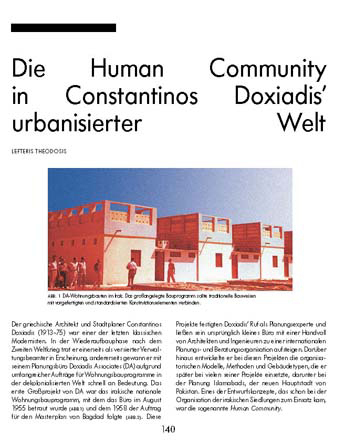
Despite being one of the New Towns of what so far has been the 21st century, and a future landmark project of Pakistan, DHA City has a peculiar planning past. From 1959 to 1963, Doxiadis Associates developed the master plan of Islamabad, conceived as the new capital of Pakistan. Sir Robert Matthew and RMJM had a share in the design of several buildings, while the whole venture originated in an economic plan of Pakistan, devised in the mid-1950s by a Harvard Advisory Group under the auspices of the Ford Foundation.
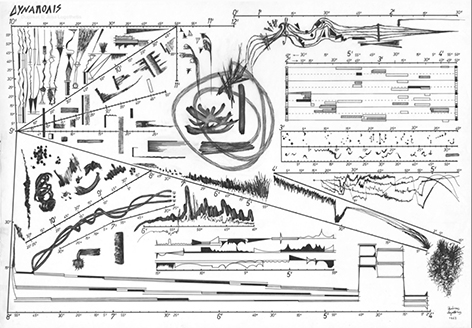
The design of Islamabad brought forward the most complete and ambitious realization of Dynapolis, Constantinos Doxiadis’ planning solution to the management of postwar urban growth, and an alternative to modern planning that was facing criticism. Dubbed by Doxiadis as “The City of the Future,” Islamabad followed the planning principles of Ekistics, easily identified in the video of the DHA project: hierarchical scale of the Ekistic units, the classification of the residential areas in communities of classes, public facilities in walking distance from the residences, etc.
In the case of the DHA City, as Ziyad Mahmoud, associate at RMJM explained, “This theory promotes the concept of mixed use residential sectors by creating multiple centres within them spreading facilities such as commerce, amenities and parks throughout these areas. The principle behind the master plan is a group of self-sustaining cities within a city, with community amenities accessible to all residents within a 10 minute walk.”
For those acquainted with the work and theory of Constantinos Doxiadis, the methodological and theoretical parallelisms between Islamabad and DHA City, can only but provide the background to debate and questions. Are DHA City and the development of the Karachi area a mere proof of Islamabad’s failure as a national capital, or the perfect reasoning of its existence? Is Ekistics pertinent to contemporary urban-regional planning? Are any global, universal, humanistic values that planning should account for? What is the role of theory in applied sciences as urbanism and regional development? Do we still miss a critical view on our planning past?
A collaborative project in which a select group of designers
illustrators, and artists create visual interpretations of
the most defining moments in United States history as a way
of informing others of our proud, yet sometimes troubled
and forgotten past.
At the UN “Habitat” Conference, which took place in
Vancouver, Canada in 1976 – a year after C.A. Doxiadis’
death – Jacky [Tyrwhitt] participated in the
Non-Governmental Organizations’ (NGO) Forum as
representative of ACE and consultant editor of its
journal EKISTICS, but like all of us, also as a member of
the WSE, an NGO accredited to the UN. Gwen Bell and Rebecca
Ruopp Packard, then editor and assistant editor of the
journal, were also there. They came bearing printed
“T” shirts with the name of EKISTICS on the front and the
statement “I am an Anthropos” on the back. Jacky was
delighted with the idea and was the first to wear it,
circulating among the young participants at the Forum.
[excerpt from Panayis Psomopoulos' "Jacky and the World
Society for Ekistics," Ekistics 314/315, 1985 ]
Undoubtedly, Jacqueline Tyrwhitt was one of the last Moderns. She worked willingly as the ‘woman behind the man’ – notably as a disciple of Patrick Geddes, translator and editor of Sigfried Giedion, and collaborator of Constantinos Doxiadis. In doing so she extended their influence greatly and shaped the work of many people.
Moreover, as the aforementioned anecdote recounts, Jacky was committed to the socio-ecological objectives of Ekistics and she would do anything to get the message through, even wearing a logo T-shirt at an official UN summit! Challenging, effective, and with a dose of naivety, was modernity once.
As Crimson eloquently declare for their forthcoming exhibition at the 13th International Architecture Exhibition of the Biennale di Venezia, “We want architecture to re-engage with the banality of urban planning, as a force for the good.”
Read: Ellen Shoshkes, “Jaqueline Tyrwhitt: a founding mother of modern urban design”
1954 photographs from the early U.S.’ space program. Taken by Life magazines’ staff photographer, Ralph Morse (1917). Morse established life-long friendships with the astronauts of NASA, as he joined them in their training, during a thirty-year assignment. He became the eighth astronaut of Project Mercury.
Jet Age Man
Man w. patterns of light covering his face and shoulders
in Air Force study in making flight helmets in small,
medium & large by measuring head w. light-beam contour map.
The 7th single from the collaborative album of Jay-Z and Kanye West, Watch the Throne (2011) was released in May, 2012, soon to be followed by the music video of Romain Gavras. Undoubtedly, the fruit of this collaboration is at first sight impressive: a furious mob clashing with riot control squads, molotov cocktails juxtaposed to fireworks, and violent scenes unfolding under the silent gaze of the statues (symbols – or just remnants?- of a glorious past). All in all, the video is set in an epic yet decadent ambient, resulting ambiguous and misleading. While filmed in Prague, the mob principally fits the “benefits looters wearing hoods” description of the 2011 British riots. The film explicitly capitalizes on the aesthetics of the revolt, even if the song has nothing to do with the occupy movements that burst successively across the globe.
Coke on her black skin
Make a stripe like a zebra, I call that jungle fever
You will not control the threesome
Just roll the weed up until I get me some
The lyrics pronounced by the characteristic Kanye West “auto-tune” voice effect do not fit the image. And the song goes on, juxtaposing love, sex, monogamy, religious dogmas and philosophical concepts. Several things get conflated here, and most of them have little – if anything – to do with the undergoing and escalating social unrest.
Surprisingly (?), the video instead of featuring a fast-car-wet T-shirt aesthetics turns to one of the hot issues of our society. Romain Gavras draws on the aestheticization of the violence that overwhelms social protests, offering us slow motion high adrenaline scenes, a recipe he had previously staged in boxing rings or the Arab desert. Compared to the M.I.A “Born Free” clip, however, “No Church in the Wild” has an ambiguous narration. While the former portrays the suppressive methods of an authoritative state – in that case U.S. – the latter stages a fight where both sides clash “for the shake of it”, principally driven by high dose of testosterone.
While certainly this can be the case of several rioters and looters, revolt’s narrations or representations cannot be simplified to a sport or a fight transmission. These are complex phenomena that bind to our political and social structures and therefore need to be examined thoroughly and critically. The recent Greek protests, for example, have witnessed bullying operations by parastatal mechanisms and fascist groups – surviving to date since the devastating civil war (1946-49) – that mislead (in real time – no camera tricks played) and discredit (in media time) the essence of the social demands in question.
In 1969, Costas Gavras (Romain’s father) directed the acclaimed film Z, a political thriller presenting a thinly fictionalized account of the events surrounding the assassination of leftist Greek politician Grigoris Lambrakis, in 1963. Z stood for the popular slogan Ζει, meaning “he (Lambrakis) lives.” In an open confrontation with the Greek military junta (1967-1974), Z – featuring the soundtrack of Mikis Theodorakis – read in its credits’ disclaimer: “Any resemblance to real events, to persons living or dead, is not accidental. It is INTENTIONAL.”
Many things have changed since the 1960s and Z, besides the first name of the director. Nevertheless, this example clearly insinuates a shift in the representation of riots and social unrest, in favor of the spectacle. Events and symbols have a firm grip on social imaginary and are therefore used according to the objectives of every director.[1] The only hint left by Romain Gavras in “No Church in the Wild” is the ΕΛ.ΑΣ (the Greek police) logo that decorates the riot control uniforms. Impressionism and opportunism, however, do not generate debate, only comfortable numbness.
[1] Costas Gavra’s “Parthenon” short movie, commissioned by the Hellenic Ministry of Culture, did not spare criticism on the Orthodox Church, depicting black glad Christian’s defacing the Parthenon sculptures in (apparently) A.D. 438. A censured version of the clip was projected at the inauguration of the New Acropolis Museum.